Trigger PVA: Ineffective Trigger
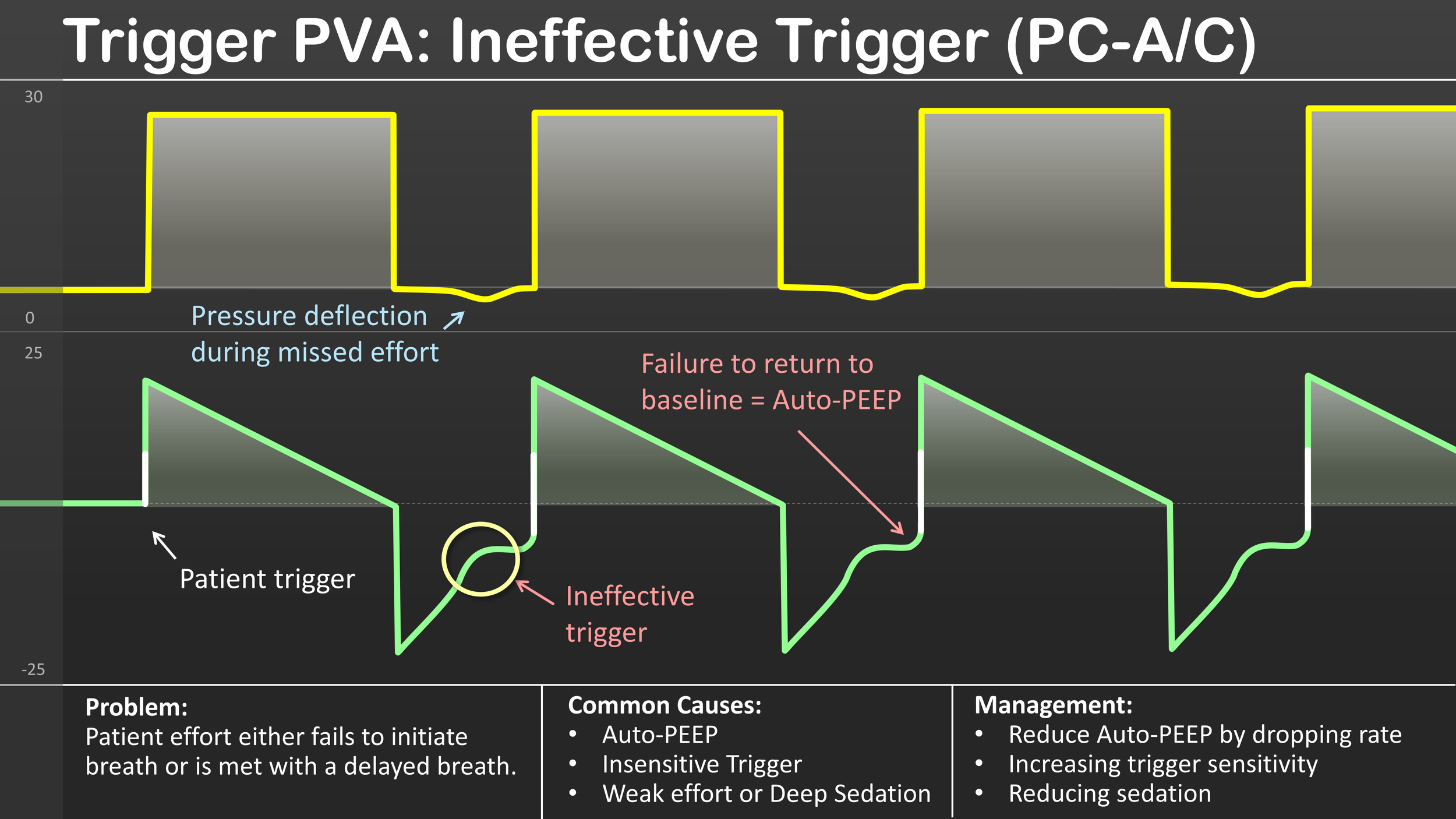
Ineffective triggering is a form of patient-ventilator asynchrony (PVA) that occurs when the patient attempts to initiate a breath but the ventilator fails to recognize the effort. This failed trigger is reflected as a negative deflection on the pressure scalar, and a corresponding positive inflection during the expiratory phase on the flow scalar. This failure of the ventilator to recognize patient effort can be met either with a delayed breath or no breath at all.
Common Causes
Typically, ineffective triggering is caused by the accumulation of Auto-PEEP (air trapping). This occurs when there is residual air that remains in the lungs at the end of exhalation due to inadequate expiratory time. This can cause a situation where the intrinsic pressure must be overcome before a breath can be triggered. Other common factors that may lead to ineffective triggering include:
Weak inspiratory effort (e.g., sedation, fatigue, diaphragm atrophy, etc.)
Insensitive trigger setting.
Why It Matters
As in all forms of PVA, ineffective triggering may cause increased work of breathing which may lead to discomfort, ventilator-induced lung injury (VILI) and can delay liberation from mechanical ventilation.
Management
Decrease auto-PEEP (increase expiratory time, reduce rate or tidal volume)
Increase trigger sensitivity (make it easier to trigger a breath)
Optimize sedation and assess for respiratory muscle weakness
Clinical Pearl: If the patient seems like they are trying to breathe but the ventilator is not responding to their effort, think ineffective trigger and focus on diagnosing the underlying cause.
